Onboard AI like a colleague, do not just buy it
Published 7 September 2026 · Updated 7 September 2026 · 12 min read
AI is not a new CRM. It is a new way of working, with an additional pair of brains next to your colleagues, which is why deployment fails more often than technology does. Treating an AI system as a hire rather than a purchase forces the questions procurement leaves vague: what is the role, who is the accountable owner, what does probation look like, which permissions apply, when is performance reviewed, how is it decommissioned. The metaphor is operationally useful, and it has one hard limit. The AI Strategy Session
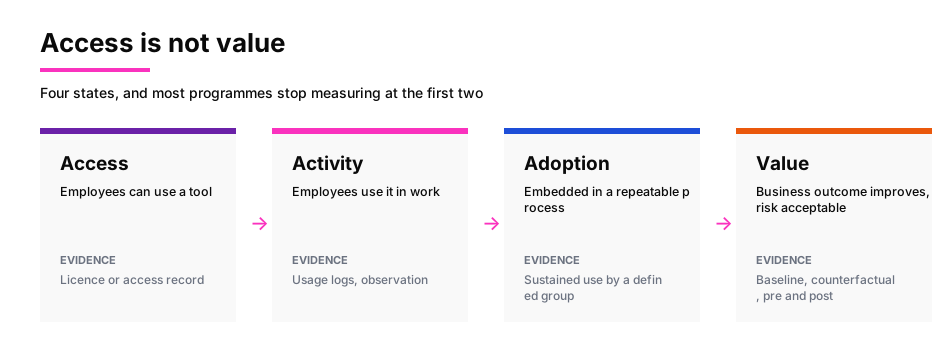
Why is AI adoption not the same as AI value?
There are four distinct states, and conflating them is how AI programmes report success while nothing changes in the work.
- 1. Access. Employees can use a model or tool. Evidence: a licence or technical access record.
- 2. Activity. Employees use it in work. Evidence: usage logs and workflow observation.
- 3. Adoption. It is embedded in a repeatable process. Evidence: sustained use by a defined group.
- 4. Value. It improves a business outcome without unacceptable risk. Evidence: a baseline, a counterfactual, or pre and post measurement.
A serious programme reaches state four, with the outcome defined in advance rather than discovered afterwards. Licence counts and training attendance are states one and two dressed as progress. The gap shows up in the aggregate numbers: nearly 90% of organisations already use AI in at least one function, 60% see minimal returns, and only 5% reach outsized results (BCG).
What does the published evidence actually support?
Healthcare is the most instructive sector here because it publishes its failures. A 2025 BMJ Health and Care Informatics report describes most institutional generative AI efforts as pilots or early deployments with few full-scale institutional adoptions, and emphasises secure data access, interdisciplinary teams, bias analysis, regulatory alignment and structured evaluation. A 2023 global implementation study surveyed 2,525 decision-makers with AI experience across China, Germany, India, the United Kingdom and the United States, and interviewed sixteen implementation experts - useful evidence that implementation problems are organisational and cross-national, though it should not be quoted as a 2025 or 2026 statistic. The Stanford AI Index Report 2025, now in its eighth edition, expands coverage of corporate adoption and responsible AI practice.
Widely circulated pilot-to-production and abandonment percentages are a different matter. They vary dramatically depending on whether pilot means a technical experiment, a funded business trial or a production deployment, and whether success means usage, savings or profit. Publishing each study's sample, date, definition and outcome measure separately is more defensible than merging them into a single AI failure rate. I have stopped quoting the merged versions, and I would treat any adviser who quotes them without a definition as guessing.
Why does software procurement misfit AI?
Traditional software procurement assumes a defined feature set, predictable behaviour, testable acceptance criteria and a vendor responsible for maintenance. Generative and agentic systems introduce variable outputs, model updates, context sensitivity, prompt dependence, data leakage risk, uncertain failure modes and a continuing need for human review.
The NEJM AI ecosystem article makes this concrete. System performance depends on interacting components including the deep-learning model, training and update procedures, guardrails, data, prompts, interaction history, human behaviour, workflows and organisational resources, and it recommends local measurement and post-market-style surveillance for mission-critical uses ("AI as an Ecosystem", NEJM AI). Procurement does not end when the licence is signed. That single sentence is the entire argument for the onboarding frame.
There is a second mismatch that procurement cannot see: the process itself. Organisations fail with AI because they attempt to scale broken processes instead of stepping back to redesign them first, an observation Deloitte's implementation work and my own deployments agree on. Your teams have usually already fixed the official process with undocumented workarounds, which makes those workarounds the most valuable data in the organisation and the first thing to map.
One deployment I reviewed had a signed licence, a completed training day, an enthusiastic internal announcement and no named owner. Three months later nobody could say who decided a new use case, who stopped a failing one, or what the tool was supposed to improve. The technology worked. The hire had no manager.
How does the hiring metaphor map to governance?
- Employment metaphor - job description
- Hiring manager
- Probation
- Access rights
- Training
- Performance review
- Manager feedback
- Offboarding
- Operational equivalent - intended use, out-of-scope use, success criteria
- A named accountable business owner
- A time-limited pilot with predefined evaluation
- Least-privilege permissions and data boundaries
- Context, examples, escalation paths, user education
- Regular quality, safety, cost and outcome review
- Human correction, error logging, prompt and workflow updates
- Revoked access, archived records, decommissioning
Wiley's human-centric AI guidance reaches the same practice from a different direction, recommending that AI systems require ongoing coaching, regular feedback, performance monitoring and continuous adjustment, and that you begin with the user's job to be done rather than the technology's capabilities (Dr Lisa Palmer, Show AI, Don't Tell It, Wiley).
Why does the frame work on people, not just systems?
It makes the human questions unavoidable. You cannot write a job description for an AI system without deciding what your people will stop doing, which is the conversation every organisation postpones.
The cost of postponing it is documented. 42% of C-suite executives say AI adoption is tearing their company apart, and 76% of executives believe their teams are excited about AI while 31% of employees actually are (BCG and Columbia Business School, 2025). That 45-point gap is not a communication problem. It is what happens when experienced professionals are asked to accept that the way they have worked through a successful career is no longer sufficient - and are then asked to scale a broken process they had already fixed themselves.
Which interventions actually address the failure modes?
- 1. Use-case selection. Prevents automating low-value or high-risk tasks first. Measure: baseline time, quality, risk and genuine user need.
- 2. Human-in-the-loop gate. Prevents silent errors and automation bias. Measure: override rate, error severity, escalation time.
- 3. Phased sequencing. Prevents premature autonomy. Simple prompts, then workflows with a human at every decision point, then agents. No one runs an ultramarathon on day one. Measure: compare the assisted, workflow and agentic stages separately.
- 4. Team co-design. Prevents workarounds and rejection. Measure: adoption by role, qualitative friction, observed process change.
- 5. Executive personal use. Prevents symbolic sponsorship without understanding. Measure: leadership usage tied to visible workflow change.
- 6. Literacy programme. Prevents misuse and over-trust. Measure: scenario-based competence rather than attendance.
- 7. Error-tolerance policy. Prevents hidden failures and non-reporting. Measure: incident rate, near misses, reporting volume.
- 8. Kill or continue review. Prevents zombie pilots. Measure: a quarterly value, risk and strategic-fit decision.
What does governance built in rather than bolted on look like?
The Barcelona GenAI Health Hackathon at Hospital Clínic offers a concrete model. Multidisciplinary teams worked with anonymised clinical data in a secure environment, with access policies, bias analysis, performance evaluation and regulatory alignment built into the process rather than added afterwards (BMJ Health and Care Informatics, 2025). The transferable lesson is sequencing: governance and evaluation were part of the build, not a review at the end.
The BMJ's clinical documentation work adds the practice that generalises furthest beyond medicine - maintain approved-tool registries, training, performance monitoring and incident reporting, and document explicitly how AI contributions were accepted, modified or rejected. Any organisation can adopt that last one this quarter at almost no cost, and it is the single best defence against the question "who decided this".
Where does the metaphor mislead?
It has no moral agency, no employment relationship, no interests and no independent accountability. Anthropomorphic language can lead users to overestimate understanding, underweight uncertainty, or treat a confident explanation as evidence of intention. That is not a pedantic objection. It is the mechanism behind automation bias, where fluent output gets approved rather than investigated, and it is documented most clearly in clinical settings where the stakes forced someone to study it.
The stronger governance principle: manage the system with the discipline you would apply to a high-impact operational capability, while keeping responsibility explicitly human. BMJ guidance states that clinicians retain responsibility for final decisions, and that organisations must supply safe tools, procurement standards, training, monitoring and incident reporting. That principle transfers to every sector without modification.
So use the frame for what it does well - forcing role definition, ownership, permissions, evaluation, feedback and an exit plan - and drop it the moment it starts to sound as though the system shares the blame. It does not. You do.
What should you measure after deployment?
Time per task. Share of outputs passing the quality gate first time. Number of people actually using the workflow. Override rate and error severity. Cost per unit of output. Incidents and near misses reported. And one line nobody writes down: what result would make you stop.
There is one predictor worth more than any dashboard. Personal, hands-on governance of AI by the chief executive shows the strongest link to AI-driven EBIT of any factor measured (Thomson Reuters). Not the stack, not the infrastructure budget - the calendar. A sandbox budget for experiments, a protected slot to actually try things, and senior people visibly stepping into learning shoes do more for adoption than another licence tranche. Alongside that, keep some capability deliberately manual: Carnegie Mellon and Microsoft Research work with 319 knowledge workers found higher confidence in the model associated with less critical thinking, and Wharton reports 43% of organisations already observing declining employee qualification.
Frequently asked questions about onboarding AI
Is hiring AI just a metaphor, or does it change anything operationally?
Who should be the accountable owner for an AI system?
What does probation look like for an AI system?
Should we start with customer-facing use cases?
How do we avoid automation bias in practice?
Why do you not quote AI failure rate statistics?
What is the fastest governance improvement we can make this quarter?
Does this apply to agentic AI or only to assistants?
Diagnosis first, ideation last. The AI Strategy Session runs a readiness audit, an employee and manager survey, facilitated strategy days and a twelve-month follow-through loop. Owners and metrics before anyone leaves the room.
Read nextWhy borrowed prompts write like everyone else · Why strong technology loses the pitch · The AI Strategy Session