Why borrowed prompts write like everyone else
Published 7 September 2026 · Updated 7 September 2026 · 11 min read
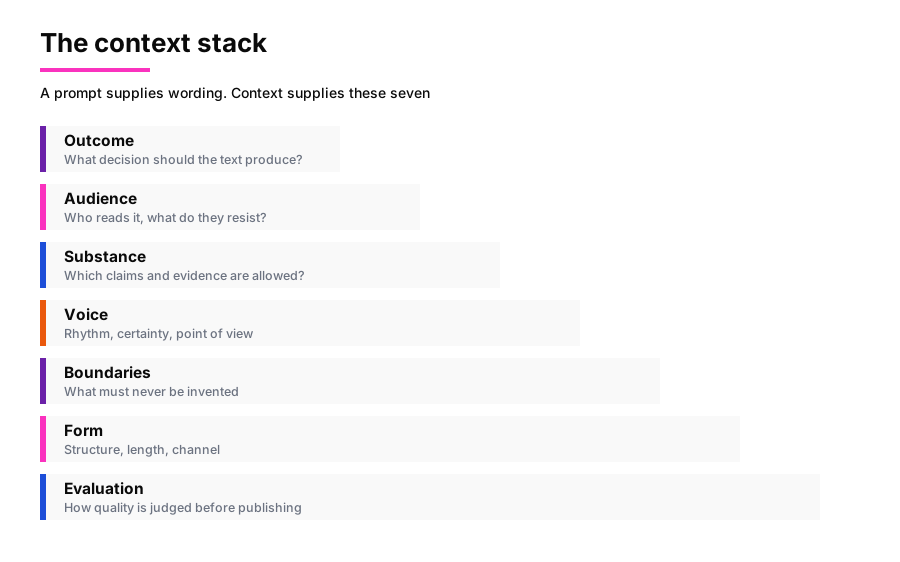
AI-generated content is neither good nor bad. It is a coping mechanism in a world with more information and less time to think. The reason borrowed prompt libraries produce interchangeable text is not bad prompting - it is insufficient task specification and insufficient source context. A prompt supplies wording. Context supplies outcome, audience, substance, voice, boundaries, form and evaluation standard. Fix the second and the first stops mattering much. See the AI Strategy Session
Why do borrowed prompts produce generic text?
An instruction like "write in a compelling thought-leadership style" leaves the model to infer audience, argument, evidence standard, voice, taboo language, structure and acceptable uncertainty from broad statistical patterns. The output is fluent but modal: familiar openings, balanced transitions, generic adjectives, predictable metaphors, a polished and interchangeable voice.
There is a deeper failure underneath it. Models do not reliably know when their context is insufficient. They answer anyway, at the same confidence. That is the mechanism behind smooth, assured, empty copy that passes internal approval and fails in market. Google Research's work on sufficient context describes exactly this gap: the model performs well when context is adequate and gives no signal when it is not.
The scale of the problem is now measurable in public feeds. Analysis of long-form LinkedIn posts suggests roughly 53.7% are likely AI-generated, and the disclosure research is uncomfortable - a Melbourne Business School study led by Professor Nicole Gillespie covering more than 48,000 people across 47 countries documents how commonly employees present AI-generated work as their own, and the trust dilemma that creates for everyone reading anything.
What is the context stack?
- 1. Outcome. What decision, action or understanding should the text produce?
- 2. Audience. Who reads it, what do they already know, and what do they resist?
- 3. Substance. Which claims, evidence, examples and counterarguments are allowed?
- 4. Voice. What sentence rhythm, degree of certainty, vocabulary and point of view define the author?
- 5. Boundaries. What must not be invented, exaggerated, disclosed or copied?
- 6. Form. What structure, length, channel and reading conditions apply?
- 7. Evaluation. How will quality be judged before publication?
Wiley's guidance on AI communication arrives at the same method from the other direction, recommending that you start with the user's job to be done, use plain language, make recommendations traceable to source data, and iterate through user feedback (Dr Lisa Palmer, Show AI, Don't Tell It, Wiley). That is a context briefing described as a communication practice.
Why is this engineering rather than prompting?
Shailesh Kachi of Adevair Technologies described the same discipline while talking about deep tech communication: in deep tech, communication isn't marketing, it's engineering for the mind. The framing transfers. You are specifying a system's inputs, constraints and acceptance criteria, which is why a maintained document beats a clever sentence. His team's own shift is instructive - they stopped using terms like multi-sensor fusion or edge inference in early conversations and explained outcomes instead: it reads the air you breathe and protects your health in real time. The simpler it sounded, the more people leaned in.
Why do style labels fail while samples work?
Style samples expose paragraph length, rhythm, use of analogy, preferred verbs, degree of qualification, how objections are handled and how conclusions are formed. Labels expose nothing, so the model fills the gap with the internet's average of that adjective.
What belongs in a curated voice set?
There is no evidenced universal number of samples that guarantees voice fidelity. It depends on how much your genres vary, whether you want surface style or reasoning habits imitated, and whether the samples contain enough examples of the target task. Anyone quoting a magic number is guessing.
- What belongs in a voice set - two or three representative finished pieces
- One piece showing how you handle uncertainty
- One piece showing disagreement or critique
- A vocabulary and phrase blacklist
- A short note on why each sample is representative
- A test set to re-run after model or prompt changes
- What does not work - adjective lists such as punchy, warm, authoritative
- A single sample from one genre
- Prompt libraries built on someone else's market
- Instructions with no example of the actual task
- A voice set nobody re-tests after a model update
- Style labels standing in for evidence rules
That last point is not housekeeping. Outputs shift when models, system prompts or retrieval change, so a voice set without a test set degrades quietly and nobody notices until a published piece reads like everyone else's.
What is the interview loop?
When you hold tacit knowledge but no prepared brief, an interview loop is more reliable than direct generation. The model asks for the customer, the tension, the specific observation, the evidence, the counterargument, the desired shift and your own stance. It drafts only after you have supplied what was missing. My most-used prompt is not "write this" but "help me structure this story by asking me ten questions".
This addresses the context-sufficiency failure directly. In practice, require the model to state what information is missing and ask targeted questions before drafting. The NEJM AI ecosystem framing explains why local practice matters more than general recipes: system performance depends on interacting components including the model, training and update procedures, guardrails, data, prompts, interaction history, human behaviour and workflows, which is why local measurement beats borrowed assumptions ("AI as an Ecosystem", NEJM AI).
A founder sent me a 900-word draft that said nothing false and nothing memorable. We ran the ten-question loop instead. Question six produced the detail that became the opening line - a specific number from a specific Tuesday. The published version used one sentence from the original draft.
What does the evidence say about disclosure and skill loss?
On disclosure, effects vary by context, audience expectation, task stakes and the quality of the disclosure itself. Saying AI assisted with editing may be fine in a low-stakes marketing workflow and insufficient when the text carries medical, legal, financial or reputational claims. In high-stakes settings, provenance and human accountability matter more than a generic label.
The BMJ literature offers a transferable standard. Its work on generative AI in clinical consultations recommends approved-tool registries, training, performance monitoring, incident reporting, and explicit documentation of how AI contributions were accepted, modified or rejected (BMJ, 2025). Transparency there covers intended use, validation context, known limitations, human oversight and accountability - not merely naming the technology. For professional writing the equivalent is disclosing material AI assistance internally, preserving source provenance, verifying claims, and naming the human editor who can defend the final text.
Does using AI erode the skill it replaces?
The accessible evidence supports caution about over-reliance without justifying a claim that AI inevitably causes skill loss. BMJ work on AI-supported case-based learning describes generative AI as potentially reducing cognitive load while noting the literature remains limited and conceptually inconsistent, and the clinical literature warns against over-reliance and de-skilling while calling for continual vigilance and AI literacy (BMJ, 2025). On the practitioner side, Carnegie Mellon and Microsoft Research work with 319 knowledge workers found that higher confidence in the model was associated with less critical thinking, and Wharton reports that 43% of organisations already observe declining employee qualification.
The practical distinction is between delegating mechanics and delegating judgement. Transcription, first-pass classification and alternative phrasing appear safe if you review the output. Problem definition, evidence selection and final judgement without review weaken exactly the capability the work was meant to build. Automation bias is the mechanism: fluent output is easier to approve than to investigate, particularly under time pressure (BMJ, ethical landscape of AI-augmented clinical documentation).
One number to handle carefully
Vendor-reported figures on AI-assisted content outperforming AI-only content circulate widely, including in my own earlier writing - human-written posts earning multiples of the engagement, AI-drafted plus human-edited content earning several times the traffic of AI-only. Comparable pre-registered experiments with disclosed quality definitions do not currently exist. Use the argument, not the percentage.
What does the quality-control workflow look like?
- 1. Extract the brief through questions before drafting.
- 2. Build a claim ledger with source, confidence and publication status.
- 3. Generate a structural outline before prose.
- 4. Draft with explicit uncertainty and counterarguments.
- 5. Run a voice audit against the curated sample set.
- 6. Run an evidence audit on every number, quotation and named example.
- 7. Remove generic transitions, unsupported intensifiers and repeated conclusions.
- 8. Human editorial pass focused on judgement rather than grammar.
- 9. Record the final prompt, context package, model version and major edits.
- 10. Re-test after any model, system-prompt or retrieval change.
Six of those ten steps are verification. That ratio is the actual difference between a content operation that survives scrutiny and one that produces volume.
Frequently asked questions about context briefings for AI writing
How long should a context briefing be?
Can AI learn my voice from three writing samples?
Should I disclose AI assistance on everything I publish?
Does using AI make my writing worse over time?
What is automation bias in a writing context?
Why do models produce confident text when they lack context?
Do prompt libraries have any legitimate use?
Does this work in languages other than English?
Bring one piece of writing you were not happy with. A 30-minute call on where the context is thin, what to put in a briefing, and what should stay human in your workflow.
Read nextOnboard AI like a colleague · Deep tech traction: what counts as proof before revenue · The AI Strategy Session