Deep tech traction: what counts as proof before revenue
Published 7 September 2026 · Updated 7 September 2026 · 10 min read
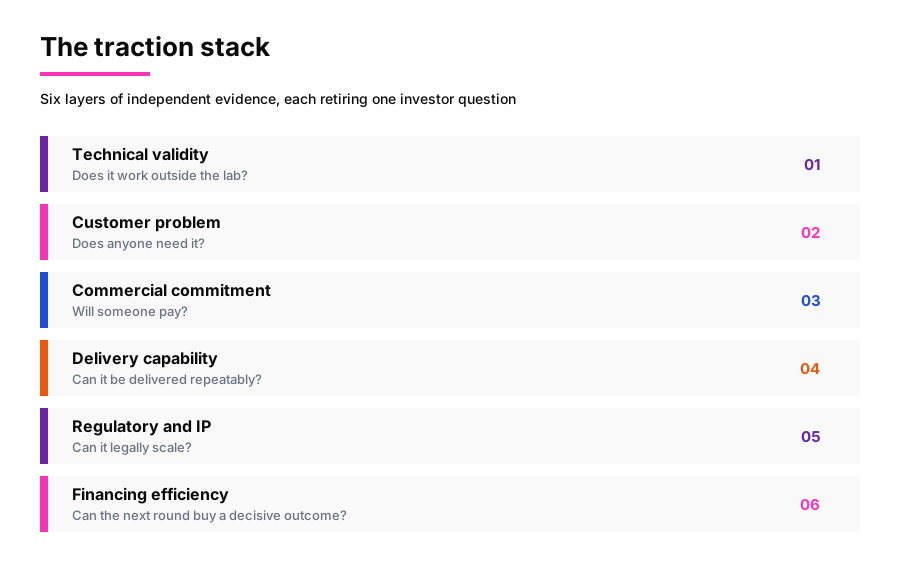
Most deep tech founders I advise sit between TRL 6 and TRL 9 with a working prototype, no repeatable buyer and a Series A conversation they cannot yet win. Traction before revenue is not one number. It is a stack of six independent signals that retire the specific risks blocking your next financing. Technology Readiness Level measures technical maturity only, which is why a company can pass TRL 7 and still fail commercially. Bring your evidence to a 30-minute call
Why is traction different in deep tech than in software?
You can vibe code almost any software to be good enough for early adopters. You can't vibe code a quantum computer, a fusion reactor or a wind turbine.
The evaluation frame most investors carry was built for a different business. SaaS-style assessment privileges rapid iteration, low marginal cost, short sales cycles and recurring revenue. Deep tech faces long industrial procurement cycles, certification gates, hardware and laboratory costs, integration work, and dependence on a small number of strategic buyers. A low customer count can reflect market structure rather than weak demand. A high pilot count can reflect unpaid experimentation rather than commercial pull.
Capital is not the constraint. Deep tech took roughly one-third of all European venture investment in 2025 at $20.3 billion, an all-time high of 32%, and while the broader tech market saw funding fall around 60% in recent years, deep tech dipped only 28% (Dealroom EU Deep Tech Report 2026). The European Innovation Council allocated €1.4 billion to deep tech startups in 2026, nearly €200 million more than in 2024 (EIC). What is scarce is evidence a generalist investor can actually read.
What is a traction stack?
The most consequential misunderstanding in deep tech fundraising is treating Technology Readiness Level as a commercial scale. It is not. TRL measures technical maturity. A company can demonstrate a working prototype in a relevant environment while lacking a repeatable buyer, a qualified manufacturing route, a regulatory pathway, unit economics, a service model or a procurement timetable.
Investor benchmarks tie stage to TRL directly: seed typically expects TRL 3-4, Series A expects TRL 5-6, Series B expects TRL 7-8. A venture is considered scale-up ready only when both Technology Readiness Level and Business Readiness Level exceed level 7 on the nine-point scale. The failure pattern has a recognisable shape - TRL 7 with BRL 3 reads as an investor pass, because strong technology is sitting on an untested business model.
Which six layers actually retire risk?
- Technical validity - independent tests, benchmark results, field performance
- Customer problem - design partner, paid discovery, quantified pain
- Commercial commitment - paid pilot, purchase order, contract, renewal
- Delivery capability - manufacturing, deployment, support and quality process
- Regulatory and IP - approval route, freedom-to-operate opinion, patent position
- Financing efficiency - milestones achieved per euro raised
- Founder-generated demo only - proves your team can run the machine
- An enthusiastic conversation - costs the other party nothing
- A non-binding letter of intent - often written before technical validation
- One hand-built unit - a prototype process rarely transfers to production
- A patent count with no freedom-to-operate analysis - proves neither demand nor the right to operate
- Capital raised as a proxy for progress - measures fundraising, not commercialisation
Revenue remains the strongest signal once it is repeatable, gross-margin visible and connected to a scalable deployment model. Before that point, paid pilots, independent validation and procurement evidence are often more informative than a small amount of non-repeatable revenue. One 2026 playbook compresses the sequence usefully: seed capital buys technical proof, Series A buys product-market signals, Series B buys the right to scale (Joltoo Deep Tech Funding Playbook 2026).
Why does a stack beat a single metric?
The useful question is not what monthly recurring revenue is, but which uncertainty has been retired, how independently it was verified, and what the next capital-efficient proof will be.
Bernard Marr's work on technology trends makes the adjacent strategic point: emerging technologies create advantage when organisations act early, but the value comes from connecting the technology to organisational change rather than from novelty itself (Bernard Marr, Tech Trends in Practice, Wiley). For a founder that means describing every technical milestone in the language of customer risk, deployment economics and timing. The milestone is the input. The retired risk is the output, and the output is what gets funded.
Which traction signals do investors actually value?
- 1. Non-dilutive grant. Validates technical importance and extends runway without dilution. Failure mode: grant selection may reward scientific merit rather than buying intent. Conversion: tie the grant milestone to a customer test, regulatory milestone or manufacturing proof. For European teams the arithmetic is favourable - the EU Unified Patent covers 18 countries for roughly €5,000 over ten years, one of the cheapest credibility assets available.
- 2. Letter of intent. Indicates interest and can open procurement access. Failure mode: non-binding, unfunded, frequently written before technical validation. Conversion: name the buyer, the use case, volume, timing, decision process and conditions.
- 3. Paid pilot. Demonstrates willingness to allocate budget. Failure mode: consulting disguised as product revenue. Conversion: define success criteria, a deployment owner, a conversion date and expansion economics. Pilot-to-paid conversion above 40% is the benchmark investors read as a working commercial engine.
- 4. Independent laboratory validation. Reduces technical credibility risk. Failure mode: laboratory conditions may not represent field conditions. Conversion: use a test protocol that maps to the customer's own acceptance criteria.
- 5. Patent portfolio. Supports defensibility in diligence. Failure mode: patents prove neither demand nor freedom to operate. Conversion: add a freedom-to-operate opinion and link claims to product architecture.
- 6. Manufacturing readiness. Reduces scale-up risk. Failure mode: a prototype process that does not transfer to production. Conversion: show yield, cycle time, supplier qualification, quality assurance and the cost-down path.
One advisee had four letters of intent and no meeting past the first. The documents named no buyer role, no volume and no decision date. We rewrote one into a two-page paid pilot scope with a named budget owner and a decision date. That single document changed the second conversation from "interesting" to "who signs".
Where does third-party validation come from before you have customers?
Institutions are the underused route. Three months ago I was invited to CERN by the Knowledge Transfer Group and started looking at CERN as a deep tech accelerator rather than a science museum. Five technology families are available for commercial transfer - aerospace, environmental, quantum, radiation, and AI and machine learning - and CERN Venture Connect offers an equity-free worldwide licence for ten years with a 2% royalty that starts only after 1 million CHF in sales (CERN Venture Connect). That is not how deep tech licensing usually looks, and an institutional licence is validation no investor can dismiss as founder enthusiasm.
Why do founders and investors disagree about traction?
Founders often treat a successful technical demonstration as evidence that the hardest work is done. Investors see unresolved commercialisation, manufacturing, regulatory or financing risk. Neither is being unreasonable. They are answering different questions.
The disagreement sharpens when technical and business readiness diverge. A company can be technically ready for a field trial and commercially unready because the buyer lacks budget authority, procurement runs eighteen months, the product needs systems integration, or the regulatory classification is unresolved. The Theranos experience made the underlying point permanent: what investors buy evidence of is business readiness, not technological readiness alone.
The fix is structural rather than rhetorical. Show two roadmaps - technology and commercialisation - with the dependencies between them made explicit. Most decks show the first and leave the investor guessing at the second, which is how a strong company loses to a clearer one.
What does the funding data really show?
PitchBook profiles show what is genuinely knowable from public sources. Deep Principle records multiple seed and early-stage rounds from 2024 through 2026 with total funding of approximately $199.4 million, including a large early-stage financing in July 2026 (PitchBook company profile). DeepLook Medical records financing activity including a later-stage venture round dated 26 December 2025 (PitchBook company profile). Both are financing-event evidence. Neither tells you whether the company reached repeatable revenue, what its gross margin is, or how many pilots failed on the way.
There is a structural reason to plan for an international Series B from your first seed conversation. The average deep tech Series B is around $40 million, implying a lead commitment near $20 million, and fifteen such positions require a fund of roughly $300 million - while 87% of dedicated European deep tech investors run funds below that threshold. The consequence is visible in the data: 61% of late-stage megaround capital comes from non-European investors (Dealroom EU Deep Tech Report 2026).
Which traction claims should you stop repeating?
There is no reliable public 2025-2026 table of median round sizes by deep tech subsector, and no comparable dataset on time from prototype to first repeatable revenue. Figures may exist behind proprietary interfaces, but inaccessible numbers should not be reconstructed from snippets or secondary commentary.
The same discipline applies to widely quoted claims about how many deep tech companies stall and for how long. Unless the denominator, subsector, geography and definition of first revenue are disclosed, the number is unverified. The absence of longitudinal TRL 6-to-revenue datasets is the real gap in this field. Founders who repeat the folklore version end up defending someone else's statistic in a diligence call, which is an expensive place to discover it has no source.
What belongs on a deep tech board dashboard?
Technical performance against an externally relevant benchmark. Number and quality of design partners, with named owners and next decisions. Paid-pilot conversion, deployment duration and expansion rate. Manufacturing yield, cost, cycle time and supplier concentration. Regulatory and certification milestones. IP and freedom-to-operate status. Cash required to reach the next irreversible commercial proof. Financing efficiency, measured as milestone achieved per unit of capital deployed.
The narrative on top of it states four things and nothing else: what has been proven, what remains uncertain, who owns the next test, and what result would change the plan. European deep tech companies that get this right reach unicorn status in an average of five years and seven months, against seven years and eleven months for regular tech - 28 months faster (McKinsey). The speed does not come from better science. It comes from retiring the right risk in the right order.
Frequently asked questions about deep tech traction
Is a grant really traction, or is it just money?
Do unpaid pilots count as traction?
We are at TRL 7 with no letters of intent. Are we fundable?
Should we mention manufacturing readiness if we have none yet?
How do we size a market that does not exist yet?
What is the difference between TRL and BRL, and why do investors ask about both?
Why do you flag some statistics as unverified rather than just using them?
How long does the path from prototype to first repeatable revenue actually take?
Bring your coffee and your challenge. A 30-minute call: what you have proven, what is still uncertain, and which evidence your next round will actually ask for. You leave with a structured view of where you stand.
Read nextWhy strong technology loses the pitch · Onboard AI like a colleague · The AI Strategy Session