Why strong technology loses the pitch
Published 7 September 2026 · Updated 7 September 2026 · 11 min read
Deep tech founders get offended when I ask them to compress forty slides into one page. "It can't be simplified, all details are critical." Investor narrative is a compression problem: you have to make the commercial consequence intelligible to a generalist while creating a credible path into technical diligence for a specialist. That needs two layers, not a shorter deck. This article also names five widely repeated pitch claims that have no traceable source, including two I used myself. Talk it through on a 30-minute call
What is the actual communication problem in a deep tech pitch?
Paul Graham's framing has lasted because it is accurate: people who are bad at explaining, talking to people who are bad at understanding.
Judging three competitions across the UK and CEE last year and watching more than ten others, I saw one failure repeatedly. Founders put every idea and the entire feature backlog into a 180-second pitch. A fog machine, not a flashlight. Meanwhile the buyer-side data shows how little room there is for that: 79% of enterprise buyers complete their research before the first sales call, and 73% of decision-makers say they trust thought leadership over marketing materials. The room has already formed a view, and your job is to make the evidence legible rather than abundant.
There is a second-order problem specific to scientists. Scientists are trained in logical-scientific communication, which aims to provide general truths judged on the accuracy of claims. Narrative communication aims to provide reasonable depictions of individual experiences, judged on the plausibility of situations. Those are different success criteria, which is why selling can feel inappropriate and storytelling can feel like manipulation to a founder who has spent a decade in the first mode.
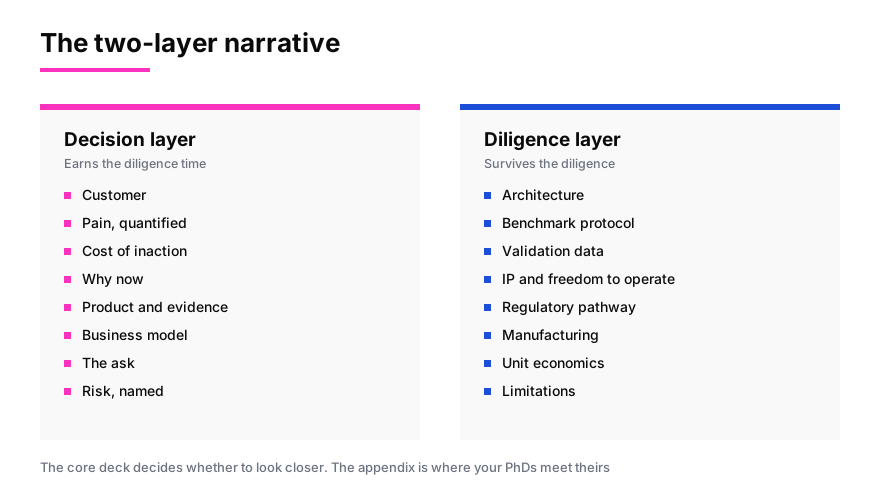
What is a two-layer narrative?
Investors cannot process every technical detail with equal depth during an initial screen. They use prior patterns, category knowledge, perceived fluency, and the questions the first explanation generates. Jargon signals expertise to a specialist and increases cognitive load for a generalist when it is not connected to a business consequence.
- Decision layer - customer
- Pain, quantified in money, time or mission failure
- Cost of inaction
- Why now, with evidence rather than optimism
- Product and the evidence it works
- Business model and the financing milestone
- Risk, named before it is asked about
- Diligence layer - architecture
- Benchmark protocol and validation data
- IP position and freedom to operate
- Regulatory pathway
- Manufacturing and deployment
- Unit economics detail
- Technical limitations, stated plainly
This is not simplification for its own sake. It is information architecture. The core deck enables a decision about whether to spend diligence time; the appendix enables that diligence. Simplification is what gets you funded, partnered and scaled, and it is the thing founders resist hardest because years of research sit behind every slide.
Why does the evidence have to be encoded, not just included?
The relevant claim is not that investors are irrational or that storytelling overrides evidence. It is that evidence must be encoded in a form that lets the listener identify what it proves, what it does not prove, and which question should be tested next. A deck that leaves those three ambiguous fails regardless of the quality of the science underneath.
Market sizing is where this breaks most often. Around 55% of decks reviewed in 2024 carried inadequate market analysis, and bottom-up sizing is currently treated as roughly twice as credible as top-down. Published benchmarks for early-stage B2B companies sit at 1% of serviceable market in year one, 3% in year two and 5% in year three (MicroVentures, January 2026). Claiming 10% in year one without an operational plan raises immediate flags, and a serviceable-obtainable figure that implies $45 million of revenue while the model shows $20 million destroys credibility on the spot.
"It's like a Star Wars shooter" is one of the best pitch openings I have heard. The technology shared nothing with the film. The analogy created a slot in an overwhelmed investor's head for the innovation to occupy, and engaged everyone in the room who grew up on the franchise. An analogy is not dumbing down. It is addressing.
Which narrative techniques actually hold up?
- 1. Problem-first framing. Establishes relevance before mechanism. Fails when the problem is generic or unquantified. Measure: can the investor restate your customer and their pain afterwards.
- 2. Consequence framing. Makes urgency economically legible. Fails when the cost of inaction is inflated. Measure: the quality of the questions coming back.
- 3. Analogy. Gives a mental handle for unfamiliar technology. Fails when it implies the wrong mechanism. Measure: comprehension, and how often you must correct the technical picture afterwards.
- 4. Why-now evidence. Connects timing to external change. Fails when the trend is unrelated to a buying trigger. Measure: second-meeting conversion by narrative version.
- 5. Category naming. Helps investors place you. Fails when the category is vague or unsupported. Measure: whether investors describe you consistently to each other.
- 6. From-to transformation. Shows what changes for the customer. Fails when it ignores adoption and switching costs. Measure: customer validation and pilot scope.
- 7. Audience-specific versions. Reduces irrelevant detail. Fails when versions create inconsistent claims. Measure: conversion by investor type.
- 8. Technical appendix. Preserves credibility without overload. Fails when the appendix hides unresolved risk. Measure: diligence progression and question quality.
- 9. Objection pre-emption. Signals realism. Fails when it sounds defensive or over-scripted. Measure: time to resolution of the key diligence issue.
- 10. Rehearsal. Improves clarity under pressure. Fails when it polishes delivery without fixing the evidence. Measure: recorded comprehension and Q&A performance.
What does the from-to transformation look like in practice?
The pattern is visible in companies that have raised at scale. Relativity Space, valued at $4.2 billion, could describe wire-arc and powder-bed metal additive manufacturing systems for large monolithic aerospace structures in proprietary nickel and aluminium alloys. What they say instead is that they print rockets like software updates. Recursion Pharmaceuticals, at $2.13 billion, integrates high-throughput phenomics, transcriptomics, proteomics and ADME profiling into a unified data pipeline - or, as they put it, microscope-based AI for drug discovery. PsiQuantum, past $1.3 billion, builds photonic quantum computers using silicon photonics fabricated at existing semiconductor foundries: quantum chips built in the world's existing chip factories, at industrial scale.
Three golden rules produce those lines. Output, not process, because nobody cares how the technology works and everybody cares what they get out of it. Analogy first, to get through the cognitive barrier before the audience's attention closes. And the so-what test after every technical claim, repeated until you land on a currency figure, a minute saved or a risk avoided.
How do you measure whether the narrative worked?
Deck analytics measure viewing behaviour. A slide viewed for longer may be confusing rather than compelling. A short deck may perform well because the investor already knew the company, not because a technique caused the outcome.
The sequential measures are stronger. Does the investor correctly restate the problem and the customer? Does the investor name the same why-now trigger you do? Does a second meeting happen with a relevant technical or commercial question? Does diligence surface fewer avoidable misunderstandings? Does the investor proceed, pass, or ask for a different evidence package? Each of those connects comprehension to a decision, which is what a single engagement statistic cannot do.
The same logic applies on the commercial side of the story. Enterprise buyers are lost to inaction more than to competitors: between 50% and 70% of qualified deals in complex B2B end in no decision at all. A narrative that does not make inaction expensive is competing with nothing, and losing.
Which pitch advice turns out to be folklore?
- 1. A universal investor attention span measured in seconds or minutes. The circulating figures require primary investor-funnel datasets that are not publicly accessible. I used one in an earlier version of this piece. It came out.
- 2. A universal best deck length or slide order. No accessible dataset supports a fixed number for deep tech. Ten to twelve core slides plus a curated appendix is a working convention, not a finding.
- 3. The claim that passion alone drives investment. The frequently cited fMRI study on founder passion and investor interest could not be verified from accessible sources. The retrievable neuroscience literature concerns financial risk-taking and investment decision-making in general - for instance an ALE meta-analysis on investment decision-making, and work on insula activation and self-reported stock trading - not a verified founder-pitch experiment. Treat the specific percentages as unsupported until the original paper, sample, task and effect size are checked.
- 4. The claim that a category name creates a market by itself. Category creation is a business decision with marketing consequences, not a marketing act with business consequences.
- 5. The claim that narrative compensates for missing evidence. It does not. It determines whether the evidence you have is understood.
Deep tech pass rates, market-sizing failure rates and deck-screening funnel data would all require primary datasets or academic replication that are not currently available. If someone quotes you a number in one of those categories, ask for the denominator before you repeat it.
What should a founder do differently on Monday?
The narrative document is six to eight pages and it is the source every other asset derives from - deck, outreach emails, the Q&A sheet, the forwardable summary. Build it in the order the investor needs: why the problem is inevitable, why now, why you, how the market maths hold up bottom-up, what proves the business model, and the ask.
Then write a jargon-free newspaper headline of under fifteen words before every investor meeting. If you cannot, the story is not ready. And name the discount yourself - investors apply a standard haircut to projections, and bracketing your own assumptions reads as self-awareness rather than weakness.
Frequently asked questions about deep tech investor narrative
Can we skip the narrative document and just fix the deck?
How long should a deep tech deck be?
What are the fifteen hardest investor questions?
Our science is genuinely complex. Where does the technical detail go?
Does rehearsal actually change fundraising outcomes?
Why did you delete statistics from this article?
Should the narrative differ for a generalist versus a deep tech investor?
How does this differ from a SaaS pitch?
Six weeks out is the right time to fix the story. A 30-minute call on where the raise stands, what exists, and what is missing. If the narrative is not the problem, I will say which part is.
Read nextDeep tech traction: what counts as proof before revenue · Why borrowed prompts write like everyone else · The AI Strategy Session